
Aging & Mental Health: What the Research Really Says
This month is Mental Health Awareness Month and Older Americans Month, making it a perfect time to explore an important question:
Does our mental health get worse—or better—as we get older?
The answer is, like most big questions, it depends.
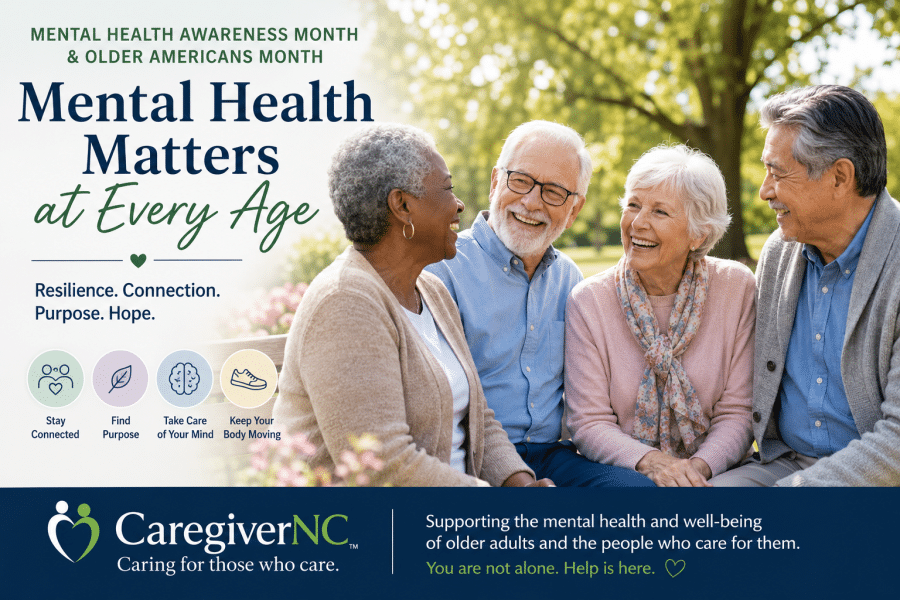
In some ways, our mental health improves with age. In fact, many older adults are emotionally stronger and more resilient than in their younger years. A study published in The British Journal of Psychiatry (2025) found that seniors often dealt with major life changes (retirement, bereavement, health issues) with little to no negative impact on mental health, and depression rates often decreased after a stressful period. Lead author of the study, Dr. Brian Beach of UCL’s Department of Epidemiology and Public Health, says, “Our results show that, on average, older adults manage to adapt emotionally after major life events, reflecting a degree of resilience.”
Despite common stereotypes, research consistently shows that older adults often report higher emotional well-being than younger people.
Why?
- Greater perspective and life experience
- Improved emotional regulation
- A clearer sense of what truly matters
Many older adults experience less daily stress, fewer emotional highs and lows, and a deeper appreciation for relationships and simple pleasures. So, while aging brings challenges, it also brings emotional steadiness and wisdom.
On the flip side (there’s always a flip side), there are real mental health risks associated with aging that we can’t ignore, and nobody is resilient all the time.
Depression, for example, can happen to seniors, and it’s often overlooked or misdiagnosed.
Depression can show up in many ways, such as:
- Low energy or fatigue
- Sleep problems
- Loss of interest in activities
- Increased physical complaints
Because these symptoms can be mistaken for “just getting older,” many people don’t receive the support they need and suffer in silence.
A surprising statistic many people are unaware of is the fact that suicide risk increases with age. In fact, older adults, particularly men over 75, have one of the highest suicide rates of any age group.
Some of the reasons for this statistic include:
- Social isolation
- Loss of a spouse or close friends
- Chronic illness or pain
- Feeling like a burden
Unlike younger groups, older adults are less likely to seek mental health support. This means older adults are often alone or isolated in grief, loneliness or loss. They face uncertainty in health, finances and many other important aspects of life.
This makes awareness and connection especially important.
What helps protect mental health as we age?
There are clear, research-backed protective factors:
- Strong relationships – even a few meaningful connections make a difference
- Purpose and routine – volunteering, hobbies, caregiving, or part-time work
- Physical movement – supports both mood and cognitive health
- Open conversations – talking about mental health reduces stigma and isolation
What many people don’t realize:
- Feeling lonely impacts health as much as some chronic conditions
- Mental health can improve with age
- It’s never too late to seek support or make meaningful changes
As a mental health counselor, I’ve worked with clients as young as 5 and as old as 85. We all struggle with the same issues. At the same time, we’re all unique, and the ways we struggle are individual to us. We also thrive and grow wise after these same struggles, facing challenges the best ways we know how.
Perhaps the one thing that unites us all is that mental health matters—at every age.